 |
December 2008 |
Briefly Noted is a short PAHO/WHO monthly bulletin containing disaster news and notes. Please feel free to share this message with colleagues. To subscribe, send your name, organization and email address to disaster-newsletter@paho.org. Briefly Noted wishes our readers a healthy and disaster-free New Year! |
| Preparedness | Safe Hospitals | Response | Advocacy | ||||||||||
Manuals Reflect Mexico's Disaster Management ExperienceIn recent years, Mexico has accumulated substantial experience in the field of disaster preparedness and response, not only through efforts at national level, but also as a result of providing support to other countries as well. This experience has been incorporated into several excellent manuals that establish a general framework and procedures for disaster preparedness and response.
These manuals (Spanish only) form part of Mexico’s 2007-12 Program on Epidemiological Emergencies and Disasters, under the General Directorate for Health Emergencies, whose mission is to protect and maintain acceptable levels of health by mitigating the impact of outbreaks, epidemics and disasters. The health disaster response manuals offer important practical considerations to protect and recover minimum levels of health in populations affected by disasters, emphasizing coordination within and outside the health sector, community level health interventions, management of the health aspects of temporary shelters, the organization and mobilization of health brigades and the organization of international health relief. In general, these publications will aid health professionals to improve their knowledge and will help strengthen overall emergency preparedness in the health sector. Although written primarily from a Mexican perspective, the key principles related to the health management of disasters and emergencies and the lessons learned should make these publications of interest to other countries with similar realities. Download these manuals at www.cenavece.salud.gob.mx/ emergencias. |
DiMAG Sets Future Commitments
for
|
| - |
Detailed terms of reference for a variety of projects. |
| - |
Training sessions for prospective check consultants. |
• DiMAG proposes that future safe hospitals measures take into account the risks associated with climate change (e.g. flooding, stronger hurricanes and storm surge) and increase awareness regarding these hazards.
• Information will be collected and published to demonstrate the need for strong motion sensors in hospitals and health care facilities located in highly vulnerable areas.
• A fire safety guide for hospitals will be developed and published and will include procedures for evacuation exercises, as part of the hospital preparedness program.
• A step-by-step, non-technical guide will be developed for the political level and decision makers to promote integration and use of existing tools in the design and construction of hospitals and health facilities.
• PAHO and DiMAG will encourage and lend support to the June 2009 IStructE—Caribbean Division Conference on Safe Hospitals.
An Efficient Local Response in Action!
The state of Santa Catarina in southern Brazil was under the international spotlight in November and December due to widespread flooding and landslides caused by persistent rainfall. Sixty municipalities were affected with 136 deaths reported and six people missing. Almost 79,000 people have been evacuated. This has been one of the most complicated recent emergencies in Brazil and the worst for the state of Santa Catarina.
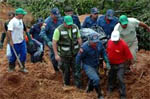
The national capacity has been praised for its well-structured disaster response coordination and mobilization at all levels. This was due primarily to Brazil's Unified Public Health System and to support from national, state and municipal Health Secretariats.
The issue of “who does what, where and how” is clearly defined in Brazil's national response strategy and it was well- translated into action:
|
• |
The Brazilian Ministry of Health coordinated the request of essential medical kits, supplies and mobile units as well as the management of government funds allocated for the response and the appointment of experts to assess the situation. Ensuring that hospitals in affected areas were operational was also a priority. |
|
• |
The State Health Secretariat spearheaded the creation of an Operations Committee comprised of the Secretariat’s Cabinet, other health agencies and the pharmaceutical and medical assistance sectors. The Secretariat also coordinated all logistics operations with the Civil Defense, contacted and triaged volunteers, managed donations and was responsible for public communications and advisories. It was also essential to undertake rapid assessment of the damage on water systems and health infrastructure. |
|
• |
Inter-sectoral assistance consisted of 12 Federal and State institutions, as well as 91 pilots and crew actively involved in the search and rescue of more than 1200 people. The Mobile Emergency Assistance Service (SAMU) and 90 health professionals supported and looked after 2500 victims in at-risk areas. |
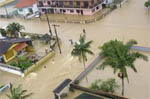
Brazil’s local response in Santa Catarina demonstrated an effective response to emergency situations. This approach is worth highlighting, as it serves as a model to adopt and incorporate into national disaster response strategies.
Click here for a map of the affected area.
Inter-agency Website Stresses What Makes Good Donations
In the July issue of Briefly Noted, we spoke at length about the enormous challenge of managing humanitarian donations in the wake of a disaster. Despite years of efforts to sensitize donors--both countries and individuals--to this issue, large quantities of unsolicited goods continue to arrive. Often, these donations place an undue burden on the national authorities of a disaster-stricken country. (Review the story in the July issue.)
Now, an inter-agency group spearheading this initiative has completed the new publication "Guidelines for Humanitarian Donations." Although currently available only in Spanish, the English version of this publication will be ready in March 2009.
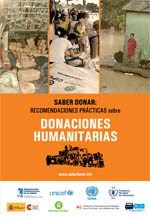
Visit the interagency website www.saberdonar.info for more about this new initiative, including a link to the Spanish Guidelines. As the English material and website are being finalized, click here to view an earlier publication on this issue.
Pan American Health Organization Area on Emergency Preparedness and Disaster Relief For more information, visit our website at www.paho.org/disasters |