 |
November 2008 |
Briefly Noted is a short PAHO/WHO monthly bulletin containing disaster news and notes. Please feel free to share this message with colleagues. To subscribe, send your name, organization and email address to disaster-newsletter@paho.org. Our print newsletter, Disasters: Preparedness and Mitigation in the Americas is now published twice a year in September and March, allowing time and space for in-depth articles, interviews and other forms of technical support for disaster management. Back issues are online at www.paho.org/disasters. |
| Preparedness | Safe Hospitals | Response | Advocacy |
General Hospital in Grenada Tests Fire Readiness
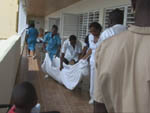
Like many other hospitals, the staff of Grenada’s General Hospital had never participated in an internal disaster simulation exercise (the exception to this was staff from the Accident and Emergency Department). Although many hospitals in the Caribbean have a wealth of experience with simulation exercises, for the most part these have been limited to external exercises used to test areas such as the response to mass casualties. However, when the Grenada General Hospital finished applying the Safe Hospitals Checklist, one of the areas found to be at high risk for fire was the facility’s oxygen bank. (The Safe Hospitals Checklist is part of the Hospital Safety Index. The standardized form assesses the safety of 145 areas of the hospital. The Hospital Safety Index was applied as part of a project to strengthen communities through safer health facilities in the Caribbean, funded by the European Union (DIPECHO) and executed by the Pan American Health Organization. Click here to learn more about the Hospital Safety Index.) To correct this deficiency, the hospital decided test its readiness to respond to a fire. The objectives of the exercise were to successfully evacuate the surgical floor, test the hospital’s command, control and coordination procedures as well as crowd and traffic control, and assess the Fire Department’s response time and its ability to deal with an oxygen fire. Smoke bombs were used to simulate a fire that started at the oxygen bank, which adjoins the hospital’s kitchen and workshop and which is also in close proximity to the administrative wing of the hospital. The hospital’s acting director made the decision to evacuate the surgical wards as a precautionary measure because oxygen lines were running directly to those wards. The response time of the Fire Department was excellent, considering the distance they needed to travel and traffic congestion. However, once they arrived, the officers were not appropriately equipped to handle an oxygen fire. Nurses had to find creative ways to move non-ambulatory patients through the emergency exits. At the end of the one-hour exercise, the staff was unable to evacuate the 30 role-playing patients from the wards. The public cooperated fully with hospital security at the entrance to the hospital. However, there was no control of the persons who were already inside the hospital compound, including the area where the fire was located. The hospital’s Emergency Operations Centre was activated and the Minister of Health, Carl Hood and the Minister of State in the Ministry of Health, Ann Peters, joined the hospital staff in the EOC, demonstrating a commitment to the importance of this learning exercise. Many lessons were learned that were shared with the Ministers and
the hospital staff during the debriefing, including problems with
the malfunctioning elevator, no fire escape in place and badly structured
exit points for the hospital. The hospital plans to use the lessons
learned to update the Hospital Emergency Plan and to implement the
recommendations. |
Just When You Thought Hurricane Season Was Over!Hurricane season officially ends each year at the end of November, yet it is rare to see major hurricanes so late in the season. Hurricane Paloma was one of them. A powerful Category 4 storm with winds reaching 225 km/h (140mph), Paloma struck the Cayman Islands and later lashed Cuba on November 8, leaving up to 12in (30cm) of rain before exiting the island.
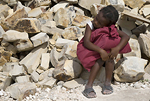
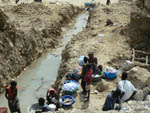
In Cuba, approximately 1.2 million people (almost 11% of the population) were evacuated in anticipation of the hurricane. Another 220,000 were relocated to 1,448 shelters, while the rest were housed in the homes of relatives and friends. Almost 10,000 homes in the municipality of Santa Cruz del Sur (province of Camaguey) were damaged and 1,353 were completely destroyed. Three family doctor clinics and a pharmacy in the area were affected as well. Safe drinking water remains a concern, although the municipality has a sufficient stock of supplies to disinfect water for human consumption. Cuban authorities continue to implement measures in the recovery phase. Temporary accommodation and food are still being provided for people who have lost their homes. General cleanup and restoration of electricity and telecommunications are ongoing, as are repairs to roads/highways, railway lines and bridges. The passage of Hurricane Paloma reminds us that the health impact does not disappear once the storm has passed. Haiti is a case in point. Although Haiti was spared the brunt of Paloma, four hurricanes and tropical storms made a direct hit earlier in the season and the effects still linger, particularly in Gonaives, where available resources are insufficient to meet needs. Gonaives was one of the hardest hit areas, and more than two months after the storms much devastation remains. More than 30 malnourished children were evacuated from the southeast community of Baie d’Orange. While there has been some improvement in coordinating interventions among different sectors, targeting has been poor in some areas due to information gaps and restricted access.
Schools reopened in Gonaives on November 10—just three days after the tragic collapse of a school building that left 93 students and teachers dead and 162 injured. A second school partially collapsed less than a week later, injuring another seven 7 students, as confirmed by the UN Stabilization Mission in Haiti (MINUSTAH). So far, only 48% of the US$ 105.7 million emergency appeal issued by the Haitian Government and UN agencies in response to the disasters of August and September has been funded. |

Pan American Health Organization Area on Emergency Preparedness and Disaster Relief For more information, visit our website at www.paho.org/disasters |