Toolkit Being Developed to Deal
with
Pandemic Influenza
PAHO/WHO has been working with Caribbean countries to coordinate
a number of activities designed to prepare for an influenza pandemic.
The main thrust has been the development and testing of a National
Influenza Pandemic Plan, advocacy for the participation of non-health
actors in these activities—particularly national disaster
and uniformed forces—and strengthening the readiness of health
institutions by developing and training in various protocols designed
to promote hospital and health center capacity to respond to emergencies.
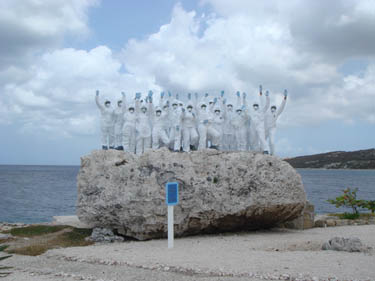
Among the novel approaches taken by the project is the collaboration,
with partners working on avian and pandemic preparedness activities,
to develop a toolkit aimed at mayors or civic leaders who may find
themselves having to deal with a panicked community and with little
additional help from outside. This collection of guidelines gives
the non-technical reader enough information to prepare a small community
for the pandemic. It is designed to complement national pandemic
plans and while it does not include hospital or health center arrangements
which would be covered in the national plan, it does have information
for the householder on how to prepare for a pandemic including what
to do with a sick person at home.
All the English and Dutch-speaking countries of the Caribbean have
developed a national plan for pandemic and most have trained outbreak
response teams to investigate suspected human cases of avian or
pandemic influenza. At present, countries are looking to strengthen
their hospital safety plans by including provisions for a pandemic.
|
The Loss of a
Health Center is a Social
as Well as an Economic Issue
Nationwide, most hospitals and health facilities in
Costa Rica were spared massive damage from the January 8th earthquake.
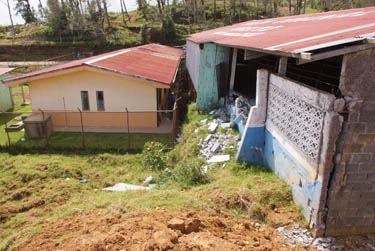
However, several small health centers did suffer severe structural
damage and are beyond repair. The village of Poasito lost its community
health center, where an integrated health team labored to improve
access to primary care. Similar centers in the small towns of Cinchona
and Vara Blanca were also destroyed or seriously affected.
The loss of these health centers has had an enormous social impact
on the affected population, as they were built with the communities’
own efforts and resources.
Close to the epicenter of the earthquake, other health facilities
that were well built and had received proper maintenance withstood
the impact and suffered very little damage, showing that it is possible
to make health facilities disaster-resilient.

The silver lining of this earthquake is that Costa Rica now has
the opportunity to build new health facilities in safe areas that
were not affected, using “safe hospital” norms and rules,
so that the communities can have access to health services when
they are most needed. It is also the time for hospitals and other
health facilities to revise and update their emergency plans, and
conduct courses and simulations to train their personnel in disaster
and emergency management. The window of opportunity will close in
a few weeks; disaster memories are short, and the (very human) trend
is that everything is forgotten, and nothing is done until the next
earthquake occurs. |
The Earthquake in Poas, Costa
Rica:
Has it Been Forgotten Already?
It has only been 20 days since a magnitude 6.2 earthquake shook
Costa Rica on 8 January, and already it’s old news. It was
one of those “minor” disasters that is profiled in the
news for a few hours or days and soon disappears. The social and
economic impact of the earthquake, however, will undoubtedly be
felt for several months to come.
The earthquake once again proved that Costa Rica is highly vulnerable
to natural phenomena and, therefore, cannot get complacent with
preparedness measures, particularly prevention and disaster risk
reduction. The country has estimated the economic losses at over
US$ 100 million. According to official information, confirmed on
22 January by the National Emergency Commission (CNE), the earthquake’s
toll was 23 deaths, 100 injured, seven missing, more than 100,000
affected, 71 communities with serious damage to vital lines (housing,
water, roads): 71 and approximately 423 houses completely destroyed.
A hydroelectric plant, hotels, crops, schools, houses, health centers,
highways and bridges suffered damage or were destroyed in the Poas
area, considered one of the most important tourist destinations
in the country. Specialists from the Costa Rican Volcanic and Seismic
Observatory, after a reconnaissance flight, observed that the ecologic
and environmental impact has been huge. In addition, approximately
1250 hectares of agricultural and livestock land has been affected.
In economic terms, the most affected areas are tourism and agricultural
exports, which represent a considerable portion of the Costa Rican
income.
A Test for the National Response System
Costa Rica has a strong national structure for the management of
emergencies and disasters. From the start, the CNE took control
of response measures, activated an Emergency Operations Center,
and deployed focal points to the affected areas. Other agencies
in the national disaster response network also got to work in rescue
operations, care of victims, and evaluation of damage and needs.
In general, and despite some minor coordination problems at the
beginning, the response was quick and efficient.
The Costa Rican Red Cross y National firefighters activated their
search and rescue teams, and performed an admirable job in the care
of the injured and rescue of hundreds of people who were left isolated
due to the damaged roads. Electricity, water, and communications
were reestablished very quickly in most of the affected areas. The
cleanup and reopening of roads and highways was also very efficient.
Only those areas closest to the epicenter remained without access
seven days after the earthquake, due to the magnitude of landslides.
Regarding humanitarian supplies, national solidarity filled warehouses
set up in locations where assistance was provided to the affected
population. Food, used clothing and shoes piled up in warehouses
Donations could have been handled better if, from the start, the
public had been encouraged to make monetary donations.
Health Situation
The health sector activated its emergency mechanisms to provide
assistance to those injured and control sanitary conditions in shelters.
The Costa Rican Social Services treated approximately 1.100 injured
people in their Basic Health Clinics (EBAIS), health centers or
areas reserved at the shelters. Only 81 people had to be evacuated
to hospitals in other cities.
In general, epidemiological surveillance and health control have
been carried out efficiently, and health services during the emergency
were satisfactory. After the first few days, psychosocial intervention
became a priority. The Costa Rican Social Security strengthened
their psychosocial service teams, and special units were deployed
to shelters.
The management of dead bodies was performed according to existing
protocols and guidelines available in the country. A temporary morgue
was created in the San Miguel de Sarapiqui school, where forensic
experts from the Judicial Investigation Agency examined, identified,
and delivered the victim’s bodies to family members.
In search of a new destiny
Although the earthquake affected a rural, sparsely populated, area,
several communities were severely affected. Cinchona became a ghost
town, where practically all buildings were destroyed. The population
was evacuated, leaving all their possesions behind.
At least 25 temporary shelters were habilitated for 3700 people.
The Ministry of Health took charge of sanitary surveillance and
control; initial reports indicated problems due to lack of latrines,
access to safe water and waste disposal in several of those shelters.
These problems, however, were quickly taken care of. By 22 January
only 1500 people remained in the shelters at Poasito, Fraijanes,
Heredia and Sarapiqui. Authorities are making plans to establish
temporary settlements for these families, where they can stay at
least six months, until a more permanent solution is found.
|
‘Safe Hospitals’
the Theme of Next World Health Day
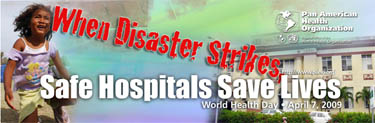
World Health Day is celebrated each April 7 to mark the founding
of the World Health Organization. This year, World Health Day’s
theme is When Disasters Strike: Safe Hospitals Save Lives.
On this day in Latin America and the Caribbean and worldwide, countries
will mark the celebration with a variety of events and activities
that focus on the importance of safeguarding all health facilities—large
or small, urban or rural—from the impact of disasters.
World Health Day is an opportunity to focus global attention on
this important issue through media attention, outreach to other
sectors and the wide dissemination of information. The ultimate
goal is to ensure that everyone can count on the fact that hospitals
and health services will be able to function in disasters and emergencies,
when they are most needed.
This broad theme will focus primarily on three important messages:
 |
All health facilities must be able to withstand the physical
impact of disasters. |
|
Critical health services must continue to function in all
emergency situations. |
|
The health workforce must be trained and ready to deal
with the particular challenges these situations impose. |
PAHO/WHO is preparing a special website with a variety of materials
related to World Health Day, including posters, FAQ sheets, a reading
library, case studies and more. Watch for the announcement of this
website soon!
What is a safe hospital?
 A
safe hospital is an establishment whose services remain accessible
and functional, at maximum capacity and within the same infrastructure,
immediately following a disaster. The term ‘safe hospital’
encompasses all health facilities, regardless of their level
of complexity. A hospital is ‘safe’ when it enjoys
the highest level of protection possible, when access routes
to the health facility are open and critical lifelines continue
to supply the health facility, guaranteeing continuity of
operations and the ability to absorb the additional demand
for medical care. A
safe hospital is an establishment whose services remain accessible
and functional, at maximum capacity and within the same infrastructure,
immediately following a disaster. The term ‘safe hospital’
encompasses all health facilities, regardless of their level
of complexity. A hospital is ‘safe’ when it enjoys
the highest level of protection possible, when access routes
to the health facility are open and critical lifelines continue
to supply the health facility, guaranteeing continuity of
operations and the ability to absorb the additional demand
for medical care.
|
|
