Briefly Noted is
a short PAHO/WHO monthly bulletin containing disaster news and notes.
Please feel free to share this message with colleagues. To subscribe,
send your name, organization and e-mail address to disaster-newsletter@paho.org.
Our print newsletter, Disasters: Preparedness and Mitigation
in the Americas, will now come out twice a year, allowing time
and space for in-depth articles, interviews and other material in
support of disaster management. The next issue will be out at the
end of September.
|
| Preparedness |
Safe
Hospitals |
Communicators Prepare to Join
PAHO/WHO Response Team
More than two decades ago, at the request of the Directing Council,
PAHO/WHO created a Regional Emergency Response Team composed of
experts with varied backgrounds in public health and disasters.
Over the course of time, PAHO/WHO recognized the need to incorporate
communications and media experts into the team to act as a bridge
between technical and public information in emergency situations
and to clearly demonstrate the health impact of disasters. To fill
this important gap, experts in the field of communications and information
management (including journalists) participated in a workshop on
methodology and tools for disaster communicators (5-7 August 2008,
Lima, Peru).
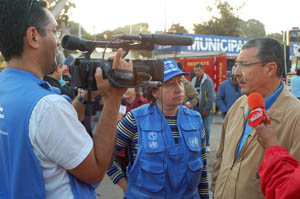
The objectives of the workshop were to:
- Strengthen the Response Team by identifying and training
communicators to assume this special role in disaster situations.
- Review and approve procedures, methodologies, tools and strategies
for communications and information management in emergencies.
During the workshop, the participants focused on the following
topics:
- Policy and technical priorities and challenges in communication
and information management, taken from experiences following the
2007 earthquake in Peru.
- Principles of crisis communications, based on regional lessons
learned.
- Tools for decision-making: damage and needs assessments, Emergency
Operations Centers, health situation rooms, etc.
- The media: how can we work together more efficiently and effectively
before, during and after disasters?
- The myths and realities of disasters—communications strategies
for dispelling these myths.
- Public health priorities in emergencies
Two modules deserve special attention. In the first, the 25 participants
took part in an exercise that simulated an earthquake in a fictitious
country. The exercise was designed to bring to light the political
as well as technical challenges that unfold in the aftermath of
many large-scale emergencies, many of which can be resolved with
well-developed communications and information management strategies.
During a subsequent work session, participants reviewed and made
recommendations to improve guidelines on communications and information
management in emergency situations. Once all recommendations are
consolidated, these guidelines will be published and incorporated
into the PAHO/WHO Emergency Response Team Manual. |
Mexico Already
Committed to Many Aspects of a
Safe Hospitals Program
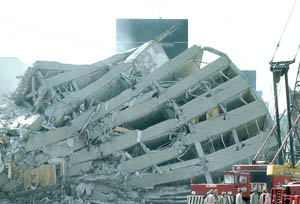
Since 2006, Mexico’s Civil Protection System
(SINAPROC) has been at the helm of a national Safe Hospitals Program,
with support from public and private health agencies. Several key
components of this Program are contributing to Mexico’s significant
advances, the first of which is a National Committee for the Assessment,
Diagnosis and Certification of health facilities. This structure
is replicated at the state level, where state committees are responsible
for conducting an initial safety diagnosis of the most important
health facilities in highly at-risk areas.
Another important component of Mexico’s Safe Hospitals Program
has been the training provided to those charged with evaluating
the safety of health facilities. These professionals, representing
a variety of disciplines from different institutions, have taken
part in formal training—part of which is web-based—and
upon passing an exam, are accredited by SINAPROC as a ‘Safe
Hospitals Evaluator.’ To date, 980 people have been trained
and 336 certified as evaluators. More information in Spanish on
the course is available at www.imss.gob.mx/curso/hospitalseguro/.
Mexico has also expanded its commitment to safe hospitals by enlisting
the support of other internationally-known institutions. The Mexican
Hospital Association, a strong supporter, made this the central
focus of the 2008 International Congress, where the theme was ‘Safe
Hospitals—a Strategy for Protection and Quality.’ Some
900 national and international participants learned of advances
in planning, organization and training for emergency situations
and vulnerability reduction in health facilities, highlighting the
many positive aspects of work that is currently underway, which
spans institutions and disciplines.
Other congresses later this year (Mexican Academy of Emergency
Medicine and the Committee for Heart and Trauma Care) will also
incorporate sessions on safe hospitals, with a view toward the functional
aspects of emergencies, disasters and pre-hospital care. Mexico
is clearly taking important steps to safeguard the nation’s
health facilities while at the same time contributing to the World
Disaster Reduction Campaign ‘Hospitals Safe from Disasters.” |
|
|
Advocacy |
Recommendations of the WHO/World
Bank
Post-earthquake Mission to China
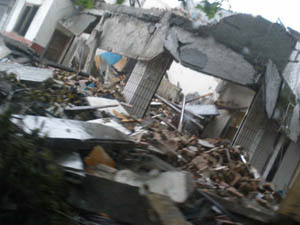
A World Health Organization/World Bank team evaluating the health
impact of the May 2008 earthquake in Sichuan province, China, made
a number of recommendations including recommendations protect hospitals
and health facilities from the impact of future disasters. The following
is an excerpt from a report by WHO Consultants Dr. Jose Luis Zeballos
and Eng. Tony Gibbs.
Recommendations for public health
Efforts are needed to:
- Fully finance with public funds, essential public health programs
for populations in earthquake-affected areas; these programs should
be scalable to include a more comprehensive range of preventive,
promotive and rehabilitative public health programs.
- Streamline the delivery of public health programs and public
health institutions in accordance with the changed population
profile and burden of disease and disability.
- Promote data integration across stakeholders involved in health
system reconstruction for coordinated care, monitoring and evaluation
and operational research purposes.
- Evaluate and strengthen the early warning alert and response
system and event-based surveillance using a risk-based, all-hazards
approach, in addition to the long-term monitoring of the earthquake
affected population and responders for the health consequences
of hazardous exposures.
- Develop all-hazards preparedness plans for the health sector
(and beyond) and test the plans through drills and exercises.
- Provide individual and community-based mental health services
to the affected population and earthquake responders.
Recommendations for health services
- Early retrofitting or reconstruction of primary health facilities
(i.e. village health stations/clinics, township health centers)
should be given top priority. Essential medical equipment/devices,
medicines and other medical supplies should be made available
as soon as possible down to the primary health facility level.
- Robust assessments of healthcare needs, damages to health facility
infrastructure and functions, and the appropriateness of the health
workforce should be carried out in a timely fashion to inform
planning. The strategy should balance the short versus longer-term
needs and should include a transitional strategy to bridge between
the emergency phase and the reconstruction phase.
- The reconstruction strategy should include rationalization
plans for health facilities at the county and provincial levels
to meet new needs. Some facilities and laboratories could be closed
or merged to reduce unnecessary competition and redundant spending,
and to focus on service provision.
- The environmental impact of clinical waste should be addressed
in the transitional period and during the planning of new facilities.
- National and local governments should revise their strategies
for health service capacity building to address the changing needs
of health care, particularly with respect to disability and mental
health services, and losses to the health workforce due to the
disaster. Services should be reviewed and revised around the changing
demographic, epidemiological and burden of disease profiles.
- In the phasing out of free healthcare after the emergency period,
the government, particularly at the national level, should increase
the funds earmarked for medical financial assistance (MFA) to
the poor and vulnerable groups to ensure equitable access to essential
healthcare. An improved benefits package should be made available.
MFA should be well integrated into the new rural cooperative medical
scheme and funds pooled into the new urban resident medical health
insurance schemes.
- In the reconstruction of the health system in the affected
areas, acceleration of universal coverage of essential healthcare,
an aspiration of China's new health system reform plan, should
be seriously considered by the government. While public health
functions and services should be fully financed by the government,
funding essential clinical services could combine payment by health
insurance schemes, government subsidies (e.g. MFA) and out-of-pocket
payments, aimed at less than 20% of out-of-pocket expenses for
the general population. Poor and vulnerable groups should have
access to free or almost free health care.
Recommendations for infrastructure
- Set up a technical working group to advise on the future relocation
of health infrastructure, land use planning and microzoning studies
before construction of health facilities.
- Recognize the special requirements of hospitals. Embrace the
Safe Hospitals Initiative of the WHO, which require hospitals
(especially secondary and tertiary facilities) to remain functional
after earthquakes.
- Ensure that essential, supporting infrastructure, such as water
supply, access to transport systems, telecommunications, and electricity,
can function after earthquakes.
- Carry out vulnerability assessments of all healthcare facilities
in Sichuan (for the short and medium term) and in the rest of
China (for the medium and long term). All affected health facilities
should be reconstructed or retrofitted and re-equipped using standards
that make them seismically safe. Consider using the Hospital Safety
Index in carrying out the vulnerability assessments.
- In the design of new facilities, focus on favourable building
concepts and favourable structural configurations.
- Consider using base isolation and other energy absorbing techniques
as economical methods for achieving functioning facilities after
earthquakes.
- Employ independent reviewers (review consultants) for the design
of all healthcare facilities.
- Share the information from post-earthquake diagnostic surveys
of damage with the construction community in China and the rest
of the world.
|
Andean Community Networks
Virtual Information Centers
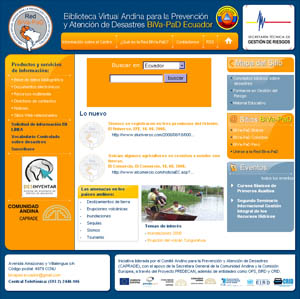
Four web-based information centers now form a network
of virtual information centers for disaster risk reduction. The
network is called BiVa-PaD (the Spanish acronym for Virtual Library
for Disaster Prevention and Response). The Andean Region’s
Strategy for Disaster Prevention and Response calls for improving
the quality of and access to technical and scientific information
related to risk management. CAPRADE is the lead implementer of this
strategy. BivaPAD has been developed with resources from the PREDECAN
Project (Support to Disaster Prevention in the Andean Community),
technical and financial support from PAHO/WHO and ISDR, and technical
execution from CRID.
The joint efforts of the four countries involved– Bolivia,
Colombia, Ecuador and Peru—have led to the creation of network
of professionals committed to disaster risk reduction and mitigation,
strengthening alliances and improving the flow of information on
risk reduction.
The BiVa-PaD network has a coordinating center in each country:
The BiVa-PaD network offers a wide variety of services:
- Databases and access to more than 4,000 electronic full-text
documents and bibliographic references related to risk management.
- A collection of 200 multimedia resources (VHS, DVD, CD-Rom).
- A directory of more than 800 institutional contacts working
in this field in the Andean Region and more than 300 related web
sites.
- Information on academic opportunities in the field of risk
management.
- Educational material for use in schools, workshops, etc.
- An overview of what the Andean Virtual Library has to offer
– available on CD-ROM—grouped by country. Each country
section contains a sampling of the documents available and lists
of national contacts and web pages.
|
Pan American Health Organization
Area on Emergency Preparedness and Disaster Relief
For more information, visit our website at www.paho.org/disasters |
|
